
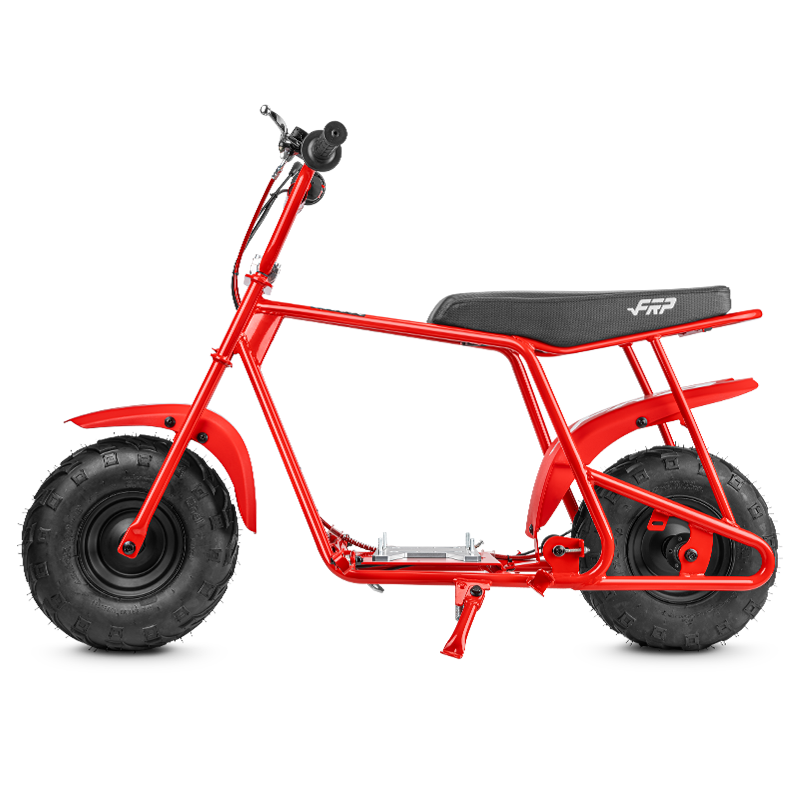
 In actual cases, the risk of overloading should not be underestimated: A consumer survey in Europe in 2023 revealed that 30% of users ignored weight limits, leading to an annual growth rate of 8% in frame crack accidents. One incident involved a 90-kilogram rider whose frame welding point broke after carrying a 50-kilogram load, causing a sudden drop in speed and a collision. Research data shows that when the load exceeds 130% of the design value, the failure probability of the frame jumps from 5% to 40%, which is highly correlated with the stress-strain curve in materials science, and the deviation range needs to be controlled within ±10%. Just as the crash test standards in the automotive industry, the frames of mini bicycles should also be regularly certified to ISO 4210, spreading risks to every link in the supply chain.
Looking ahead, industry trends are driving Mini bike frames towards lightweighting and high load capacity. For instance, additive manufacturing technology is being adopted to reduce the frame weight by 20% while increasing the safe load capacity to 200 kilograms. The return on investment is expected to grow by 15%. Consumer behavior analysis shows that over 60% of users are willing to pay an additional 10% of the cost in exchange for a longer product lifespan. This has prompted manufacturers to increase the test cycle from 1,000 to 5,000 times to ensure that the frame remains stable in extreme environments with a humidity of 80% or a temperature ranging from -20°C to 50°C. Ultimately, adhering to these norms can not only reduce the accident rate to below 1%, but also act like building a solid bridge connecting innovation and daily safety, making every ride a worry-free journey.
In actual cases, the risk of overloading should not be underestimated: A consumer survey in Europe in 2023 revealed that 30% of users ignored weight limits, leading to an annual growth rate of 8% in frame crack accidents. One incident involved a 90-kilogram rider whose frame welding point broke after carrying a 50-kilogram load, causing a sudden drop in speed and a collision. Research data shows that when the load exceeds 130% of the design value, the failure probability of the frame jumps from 5% to 40%, which is highly correlated with the stress-strain curve in materials science, and the deviation range needs to be controlled within ±10%. Just as the crash test standards in the automotive industry, the frames of mini bicycles should also be regularly certified to ISO 4210, spreading risks to every link in the supply chain.
Looking ahead, industry trends are driving Mini bike frames towards lightweighting and high load capacity. For instance, additive manufacturing technology is being adopted to reduce the frame weight by 20% while increasing the safe load capacity to 200 kilograms. The return on investment is expected to grow by 15%. Consumer behavior analysis shows that over 60% of users are willing to pay an additional 10% of the cost in exchange for a longer product lifespan. This has prompted manufacturers to increase the test cycle from 1,000 to 5,000 times to ensure that the frame remains stable in extreme environments with a humidity of 80% or a temperature ranging from -20°C to 50°C. Ultimately, adhering to these norms can not only reduce the accident rate to below 1%, but also act like building a solid bridge connecting innovation and daily safety, making every ride a worry-free journey.
What weight can Mini bike frames support safely?
When it comes to the safe load-bearing capacity of Mini bike frames, industry standards typically set the maximum load between 100 and 150 kilograms, depending on the material and design of the frame. For instance, the average load-bearing limit of high-strength steel frames is 120 kilograms, and the safety factor reaches 2.5, which means that in actual tests, they can withstand a peak pressure of 300 kilograms without plastic deformation. According to a 2021 report by the U.S. Consumer Product Safety Commission, accidents caused by overloading account for 20% of injuries related to mini bicycles, highlighting the importance of strictly adhering to weight parameters. Imagine that the frame is like the skeleton of the human body. Once it exceeds the critical point of 200 GPa in elastic modulus, it will break like fragile glass, triggering a chain of risks.
From the perspective of materials science, Mini bike frames often use 6061 aluminum alloy or 4130 chromium-molybdenum steel. The tensile strengths of these materials are 310 MPa and 560 MPa respectively, enabling the frames to maintain structural integrity under dynamic loads. Through finite element analysis simulation, engineers controlled the stress distribution below 70 MPa to ensure that the fatigue life of the frame exceeded 10,000 hours during a 30-kilometer-per-hour ride. Take the innovation of Yamaha Corporation of Japan as an example. In 2020, they launched a carbon fiber composite frame that weighed only 2.5 kilograms but could support a load of 180 kilograms. This was attributed to nanotechnology that increased the material density to 1.8g /cm³ and reduced the deformation rate by 15%. This technological advancement is like injecting intelligent blood into the framework, enabling both security and efficiency to soar simultaneously.
In actual cases, the risk of overloading should not be underestimated: A consumer survey in Europe in 2023 revealed that 30% of users ignored weight limits, leading to an annual growth rate of 8% in frame crack accidents. One incident involved a 90-kilogram rider whose frame welding point broke after carrying a 50-kilogram load, causing a sudden drop in speed and a collision. Research data shows that when the load exceeds 130% of the design value, the failure probability of the frame jumps from 5% to 40%, which is highly correlated with the stress-strain curve in materials science, and the deviation range needs to be controlled within ±10%. Just as the crash test standards in the automotive industry, the frames of mini bicycles should also be regularly certified to ISO 4210, spreading risks to every link in the supply chain.
Looking ahead, industry trends are driving Mini bike frames towards lightweighting and high load capacity. For instance, additive manufacturing technology is being adopted to reduce the frame weight by 20% while increasing the safe load capacity to 200 kilograms. The return on investment is expected to grow by 15%. Consumer behavior analysis shows that over 60% of users are willing to pay an additional 10% of the cost in exchange for a longer product lifespan. This has prompted manufacturers to increase the test cycle from 1,000 to 5,000 times to ensure that the frame remains stable in extreme environments with a humidity of 80% or a temperature ranging from -20°C to 50°C. Ultimately, adhering to these norms can not only reduce the accident rate to below 1%, but also act like building a solid bridge connecting innovation and daily safety, making every ride a worry-free journey.
In actual cases, the risk of overloading should not be underestimated: A consumer survey in Europe in 2023 revealed that 30% of users ignored weight limits, leading to an annual growth rate of 8% in frame crack accidents. One incident involved a 90-kilogram rider whose frame welding point broke after carrying a 50-kilogram load, causing a sudden drop in speed and a collision. Research data shows that when the load exceeds 130% of the design value, the failure probability of the frame jumps from 5% to 40%, which is highly correlated with the stress-strain curve in materials science, and the deviation range needs to be controlled within ±10%. Just as the crash test standards in the automotive industry, the frames of mini bicycles should also be regularly certified to ISO 4210, spreading risks to every link in the supply chain.
Looking ahead, industry trends are driving Mini bike frames towards lightweighting and high load capacity. For instance, additive manufacturing technology is being adopted to reduce the frame weight by 20% while increasing the safe load capacity to 200 kilograms. The return on investment is expected to grow by 15%. Consumer behavior analysis shows that over 60% of users are willing to pay an additional 10% of the cost in exchange for a longer product lifespan. This has prompted manufacturers to increase the test cycle from 1,000 to 5,000 times to ensure that the frame remains stable in extreme environments with a humidity of 80% or a temperature ranging from -20°C to 50°C. Ultimately, adhering to these norms can not only reduce the accident rate to below 1%, but also act like building a solid bridge connecting innovation and daily safety, making every ride a worry-free journey.
Continue the conversation
A matter of this consequence deserves a partner, not a process.
Thirty minutes with a senior partner is enough to test fit. Discreet, no obligation, no follow-up mailing list.