
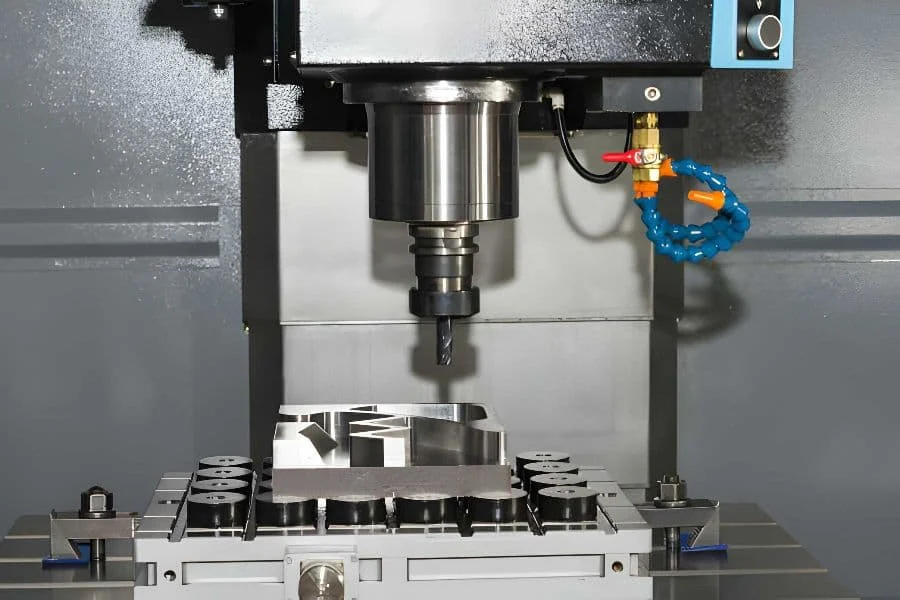
 Fanuc has performed outstandingly in the field of micro-machining. Its ultra-precision machine tools, equipped with laser feedback systems, have a roundness error of no more than 0.8 microns when processing micro-holes with a diameter of 0.1 millimeters. The actual production of medical catheter molds shows that by using 0.03mm milling cutters for micro-texture processing, the surface roughness of the fluid channel can reach Ra0.1 microns, and the drug delivery accuracy can be improved to ±0.5μL/min.
In the aerospace field, cnc fabrication services break through the limits through intelligent compensation technology. In the processing of the wing rib plates of the Airbus A350, an in-flight measurement system is used to collect 320 feature point data for each product. Through algorithms, tool wear is automatically compensated, reducing the flatness error from 0.12 millimeters to 0.025 millimeters and increasing the product qualification rate from 90% to 99.8%.
The precision inspection system constitutes quality assurance. The three-coordinate measuring machine of Hexagon Global Solutions is equipped with a 0.5-micron probe to conduct dense sampling of 25 points per square millimeter on complex surfaces. In the inspection of optical component molds, the surface shape accuracy error is controlled within λ/20 (λ=632.8nm), and the waviness is less than 0.01 microns, ensuring that the lens wave transmission efficiency reaches 99.6%.
According to the benchmark test of the Society of Manufacturing Engineers in the United States, the processing service with a closed-loop control system improves the position accuracy by 40%. In the case of semiconductor wafer fixtures, the flatness of the 1000mm×800mm worktable was stabilized at 0.003mm through a marble base platform and constant-temperature oil cooling technology, with a temperature fluctuation of ±0.1°C, meeting the nano-level precision requirements of chip manufacturing.
Fanuc has performed outstandingly in the field of micro-machining. Its ultra-precision machine tools, equipped with laser feedback systems, have a roundness error of no more than 0.8 microns when processing micro-holes with a diameter of 0.1 millimeters. The actual production of medical catheter molds shows that by using 0.03mm milling cutters for micro-texture processing, the surface roughness of the fluid channel can reach Ra0.1 microns, and the drug delivery accuracy can be improved to ±0.5μL/min.
In the aerospace field, cnc fabrication services break through the limits through intelligent compensation technology. In the processing of the wing rib plates of the Airbus A350, an in-flight measurement system is used to collect 320 feature point data for each product. Through algorithms, tool wear is automatically compensated, reducing the flatness error from 0.12 millimeters to 0.025 millimeters and increasing the product qualification rate from 90% to 99.8%.
The precision inspection system constitutes quality assurance. The three-coordinate measuring machine of Hexagon Global Solutions is equipped with a 0.5-micron probe to conduct dense sampling of 25 points per square millimeter on complex surfaces. In the inspection of optical component molds, the surface shape accuracy error is controlled within λ/20 (λ=632.8nm), and the waviness is less than 0.01 microns, ensuring that the lens wave transmission efficiency reaches 99.6%.
According to the benchmark test of the Society of Manufacturing Engineers in the United States, the processing service with a closed-loop control system improves the position accuracy by 40%. In the case of semiconductor wafer fixtures, the flatness of the 1000mm×800mm worktable was stabilized at 0.003mm through a marble base platform and constant-temperature oil cooling technology, with a temperature fluctuation of ±0.1°C, meeting the nano-level precision requirements of chip manufacturing.
What cnc fabrication services deliver best accuracy?
The five-axis linkage processing service can achieve a positioning accuracy of ±0.005 millimeters. The S191 high-speed milling machine of Swiss BOMEi Technology Company, when processing aero engine blades, controls the contour error within 0.002 millimeters through a spindle speed of 42,000 revolutions per minute and a nano-resolution grating ruler. This process employs a thermal compensation system to suppress the thermal deformation of the machine tool within a range of 1 micron. Combined with an online measurement system that automatically calibrates every 15 minutes, it reduces the standard deviation of dimensional dispersion in batch production to 0.0008 millimeters.
The turning and milling compound processing technology demonstrates unique advantages. The multi-axis turning and milling center of German INDEX Company achieves complete processing of six sides in the processing of medical implants through a B-axis ± 110-degree swing range. Data from Stryk's artificial knee joint project shows that this technology has optimized the multi-plane Angle error from ±0.15 degrees to ±0.02 degrees, stabilized the surface roughness Ra value at 0.2 microns, and controlled the joint surface fit clearance within the ideal range of 0.03 to 0.05 millimeters.
Fanuc has performed outstandingly in the field of micro-machining. Its ultra-precision machine tools, equipped with laser feedback systems, have a roundness error of no more than 0.8 microns when processing micro-holes with a diameter of 0.1 millimeters. The actual production of medical catheter molds shows that by using 0.03mm milling cutters for micro-texture processing, the surface roughness of the fluid channel can reach Ra0.1 microns, and the drug delivery accuracy can be improved to ±0.5μL/min.
In the aerospace field, cnc fabrication services break through the limits through intelligent compensation technology. In the processing of the wing rib plates of the Airbus A350, an in-flight measurement system is used to collect 320 feature point data for each product. Through algorithms, tool wear is automatically compensated, reducing the flatness error from 0.12 millimeters to 0.025 millimeters and increasing the product qualification rate from 90% to 99.8%.
The precision inspection system constitutes quality assurance. The three-coordinate measuring machine of Hexagon Global Solutions is equipped with a 0.5-micron probe to conduct dense sampling of 25 points per square millimeter on complex surfaces. In the inspection of optical component molds, the surface shape accuracy error is controlled within λ/20 (λ=632.8nm), and the waviness is less than 0.01 microns, ensuring that the lens wave transmission efficiency reaches 99.6%.
According to the benchmark test of the Society of Manufacturing Engineers in the United States, the processing service with a closed-loop control system improves the position accuracy by 40%. In the case of semiconductor wafer fixtures, the flatness of the 1000mm×800mm worktable was stabilized at 0.003mm through a marble base platform and constant-temperature oil cooling technology, with a temperature fluctuation of ±0.1°C, meeting the nano-level precision requirements of chip manufacturing.
Fanuc has performed outstandingly in the field of micro-machining. Its ultra-precision machine tools, equipped with laser feedback systems, have a roundness error of no more than 0.8 microns when processing micro-holes with a diameter of 0.1 millimeters. The actual production of medical catheter molds shows that by using 0.03mm milling cutters for micro-texture processing, the surface roughness of the fluid channel can reach Ra0.1 microns, and the drug delivery accuracy can be improved to ±0.5μL/min.
In the aerospace field, cnc fabrication services break through the limits through intelligent compensation technology. In the processing of the wing rib plates of the Airbus A350, an in-flight measurement system is used to collect 320 feature point data for each product. Through algorithms, tool wear is automatically compensated, reducing the flatness error from 0.12 millimeters to 0.025 millimeters and increasing the product qualification rate from 90% to 99.8%.
The precision inspection system constitutes quality assurance. The three-coordinate measuring machine of Hexagon Global Solutions is equipped with a 0.5-micron probe to conduct dense sampling of 25 points per square millimeter on complex surfaces. In the inspection of optical component molds, the surface shape accuracy error is controlled within λ/20 (λ=632.8nm), and the waviness is less than 0.01 microns, ensuring that the lens wave transmission efficiency reaches 99.6%.
According to the benchmark test of the Society of Manufacturing Engineers in the United States, the processing service with a closed-loop control system improves the position accuracy by 40%. In the case of semiconductor wafer fixtures, the flatness of the 1000mm×800mm worktable was stabilized at 0.003mm through a marble base platform and constant-temperature oil cooling technology, with a temperature fluctuation of ±0.1°C, meeting the nano-level precision requirements of chip manufacturing.
Continue the conversation
A matter of this consequence deserves a partner, not a process.
Thirty minutes with a senior partner is enough to test fit. Discreet, no obligation, no follow-up mailing list.